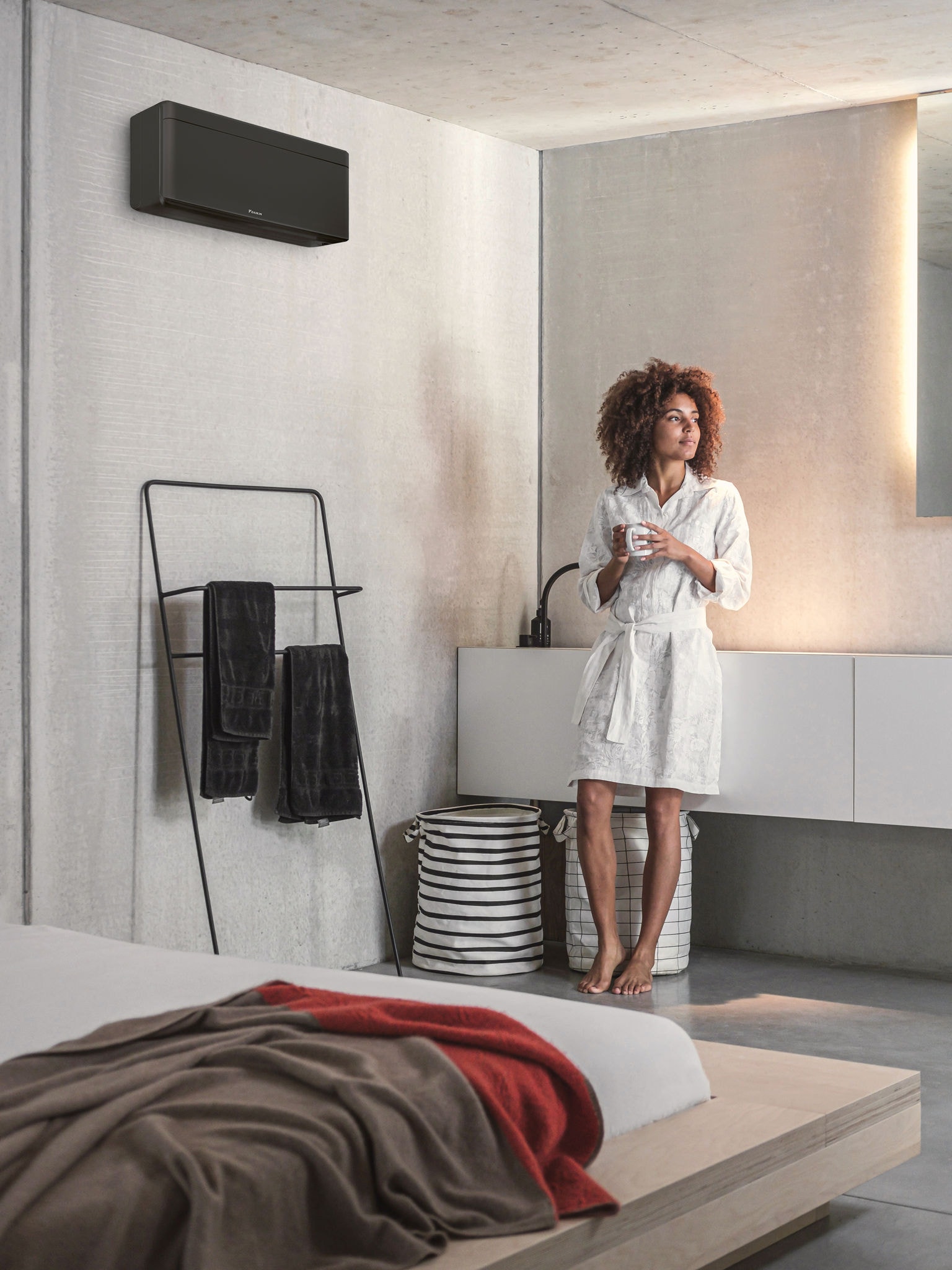
Just landed? Bring that holiday comfort home
Get year-round comfort at home with advanced, efficient heating and cooling technology.



You’ve just stepped off the plane from a place where staying cool felt effortless. Back home, comfort shouldn’t feel like a compromise. With an air-to-air heat pump, you can enjoy that same feeling in your own home — with cooling in summer, efficient heating in winter, and cleaner indoor air all year round.
Holiday comfort all year round
Struggling with a hot bedroom at night? A Daikin air-to-air heat pump gives you heating and cooling in one efficient system, perfect for keeping every corner of your home comfortable, no matter the season. It also helps purify the air inside your home, offering relief from pollen and other allergens. And with 0% VAT on Daikin air conditioners, staying comfortable doesn’t have to come at a high cost.

Government funding helps make the switch
Air-to-air heat pumps are now included in the government's Boiler Upgrade Scheme, which means eligible homeowners in England and Wales could get £2,500 off the cost of installation until March 2027. The grant applies where the system replaces an existing fossil fuel heating system. Combined with 0% VAT on Daikin air conditioners, it's a straightforward way to reduce the cost of switching to low-carbon heating and cooling.
Low carbon comfort, made for the future
Daikin air-to-air heat pumps are a smart, low-carbon choice for modern homes. They deliver energy-efficient performance and work seamlessly with renewable energy sources like solar panels, helping you make the most of your home’s energy. It’s a simple way to future-proof your home, and enjoy year-round comfort.
Start your journey to a more comfortable, energy-efficient home.
Frequently Asked Questions
NOT TRUE
An air-to-air heat pump is perfectly designed to provide comfortable and low carbon heat in winter.
In Nordic countries such as Sweden and Norway, there’s a long tradition of using air–to-air heat pumps for heating purposes. However, proper sizing is needed to make sure the product is well fit for your home: Start now!
An air-to-air heat pump (also known as an air conditioner) is typically composed of two units: The indoor and outdoor unit. These are usually called ‘split’ systems.
The split outdoor unit, mounted on an exterior wall or positioned in a garden or on a roof, is the part of an air-to-air heat pump that contains the compressor, propeller fan, circuit board and heat exchanger. The outdoor unit compresses the refrigerant that extracts or emits heat or cold in the room to or from its companion indoor unit.
The air-to-air heat pump indoor unit is the part of an air-to-air heat pump system that’s located within the home, and provides the conditioned air into the space.
The choice of an air-to-air heat pump indoor unit depends on your specific needs but it's important to understand how the system works as a whole. There are different air-to-air heat pump systems (also known as air conditioners), each with its own unique characteristics. One of the most popular types used in homes is a split system, which is split into two units: one indoors and one outdoors. While heating, the outdoor unit extracts heat from the outside air and transfers it inside via the indoor unit, or reverse when cooling your home.
There are three types of air-to-air heat pump indoor units:
Wall-mounted units
Wall-mounted models (Stylish, Ururu Sarara, Daikin Emura, Perfera,) come in different sizes and colours to match with your interior.
Floor-standing units
Floor-standing models (Perfera Floor) are compact air conditioner that fit perfectly under a window sill or in a room where the height is limited.
Concealed ceiling units
Concealed ceiling units. If you don't want a visible indoor unit, a concealed air-to-air heat pump can be installed in suspended ceilings or false walls.
Daikin's air-to-air heat pumps (also known as air conditioners) can give you relief from your allergies because they can capture the allergens in the heat pump filter and improve the quality of air that you are breathing. Not only do our air-to-air heat pumps keep you warm and cool but they are also removing pollutants, pollen and particle matter from your breathing space.
Some Daikin units are also equipped with a Flash Streamer and different filters like the titanium apatite deodorising filter or the silver allergen removal filter, which are able to reduce the pollutants in the air quickly and efficiently.
Yes, and if you renovate your property and switch to renewable air-to-air heat pumps, you will add value to your renovated home, the environment and your pocket. Heat pumps can be installed in almost any home. There are, however some considerations that may need to be addressed, particularly regarding insulation. In order for a heat pump to function at its most efficient, your home needs to be well-insulated to prevent as much heat from escaping as possible. A suitably qualified heating engineer can advise you on what needs to be done in your home in order for it to be appropriate for a heat pump system. This might include upgrading the insulation of your walls and roof. You also need to consider location. The outdoor unit will need to be installed outside your home and should be in a place that you can access easily when you need to clean the unit, adjust its settings or have the heat pump serviced.
While it’s normal for heat pumps to make some noise, they are much quieter than most people think.
A Daikin outdoor unit is usually no louder than 60 decibels, just like an electric toothbrush or a normal conversation. And the indoor units are even quieter. They make a gentle whirring noise, measuring 30 decibels at most. That’s quieter than a refrigerator. It’s as soft as a whisper.
In fact, heat pumps aren’t even allowed to be noisy. They’re not permitted to produce more than 65-70 decibels, depending on their power. That’s the same noise level as your dishwasher. And, for extra peace of mind, all heat pumps must have a CE label stating their sound level.
Learn more
Find out more about air-to-air heat pumps and how they could make a difference to your home, and the environment.